Li-Wei Qin Plays Tchaikovsky - Matinee
MATINEE SYMPHONY SERIES
Thursday 20 November 2025, 10.30am
Winthrop Hall, UWA

West Australian Symphony Orchestra respectfully acknowledges the Traditional Custodians and Elders of Country throughout Western Australia, and the Whadjuk Noongar people on whose lands we work and share music.
How to use your Digital Program
Li-Wei Qin Plays Tchaikovsky
Pyotr Ilyich TCHAIKOVSKY Variations on a Rococo Theme (18 mins)
Introduction (Moderato quasi andante)
Theme (Moderato semplice)
Variation I (Tempo della thema)
Variation II (Tempo della thema)
Variation III (Andante sostenuto)
Variation IV (Andante grazioso)
Variation V (Allegro moderato)
Variation VI (Andante)
Variation VII and Coda (Allegro vivo)
Richard WAGNER Parsifal, Act III: Prelude and ‘Good Friday Music’ (17 mins)
Richard WAGNER Die Meistersinger von Nürnberg – Suite (18 mins)
Act III, Prelude
Dance of the Apprentices
Act I, Prelude
Asher Fisch conductor
Li-Wei Qin cello
This concert does not contain an interval.
Asher Fisch appears courtesy of Wesfarmers Arts.
Wesfarmers Arts Digital Pre-concert Talk
Listen to your digital pre-concert talk below. For more information on this week's speaker, Philip Everall, see About the Speaker.
Wesfarmers Arts Digital Pre-concert Talk
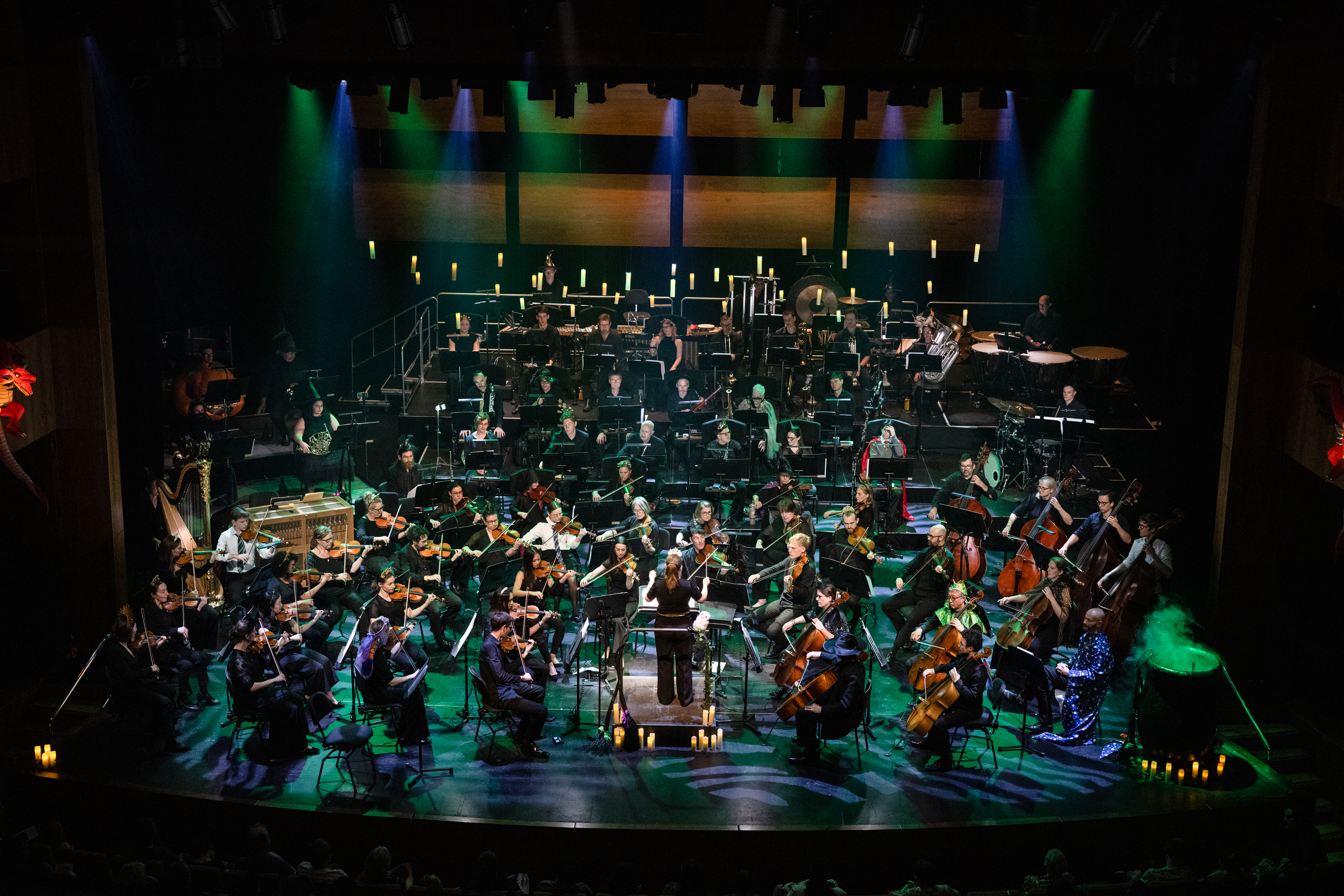
WASO On Stage
About the Artists

Asher Fisch
Principal Conductor & Artistic Adviser
Asher Fisch is a renowned conductor celebrated for his interpretative mastery of the core German and Italian repertoire of the Romantic and post-Romantic eras. Equally accomplished in both the operatic and symphonic realms, his repertoire spans from Haydn to contemporary works by living composers. Since 2014, he has been the Principal Conductor & Artistic Adviser of the West Australian Symphony Orchestra (WASO), making him the Orchestra’s longest-serving Principal Conductor. His previous positions include Principal Guest Conductor of the Seattle Opera (2007–2013), Music Director of the New Israeli Opera (1998–2008), and Music Director of the Wiener Volksoper (1995–2000).
Born in Israel, Fisch began his career as Daniel Barenboim’s assistant and Kappellmeister at the Berlin Staatsoper. He has since conducted at major opera houses worldwide, including the Metropolitan Opera, Lyric Opera of Chicago, Vienna Staatsoper, Teatro alla Scala, Royal Opera House Covent Garden, and Semperoper Dresden. His symphonic engagements have included leading prestigious orchestras such as the Berlin Philharmonic, Munich Philharmonic, London Symphony Orchestra, Leipzig Gewandhaus Orchestra, and Orchestre National de France, as well as top American orchestras in Boston, Chicago, Cleveland, New York, and Philadelphia.
In 2023, Asher Fisch was appointed Music Director of the Tiroler Festspiele in Erl, Austria, where he collaborates with the festival’s General Manager, celebrated tenor Jonas Kaufmann. Their inaugural season premiered in December 2024. The festival, held three times annually, features a diverse program of orchestral and operatic performances, chamber music, and Lied. Known for its dedication to the works of Richard Wagner, the Tiroler Festspiele will present Parsifal during Easter 2025, with Fisch conducting and Kaufmann in the title role. Each year will see the addition of a new Wagner opera production.
In 2025, Fisch’s engagements include La Bohème, Wagner’s Parsifal, and three Verdi operas at the Tiroler Festspiele, Verdi’s Il Trovatore with the West Australian Opera, Britten’s War Requiem in Düsseldorf, among other performances. Recent highlights include Reimann’s Lear at Teatro Real de Madrid, Carmen at the Vienna Staatsoper, and Dialogues des Carmélites at the Israeli Opera.
Fisch’s award-winning discography includes Bruckner’s Symphony No. 8, Wagner’s Tristan und Isolde, and tenor Stuart Skelton’s debut solo album Shining Knight, all recorded with WASO. His critically acclaimed releases also feature Ravel’s L’Heure Espagnole with the Munich Radio Orchestra and the complete Brahms symphonies with WASO, released on ABC Classic. His two recordings of Wagner’s Ring Cycle (with the Seattle Opera and the State Opera of South Australia) garnered widespread acclaim, with the latter winning ten Helpmann Awards, including Best Opera and Best Music Direction.
In addition to his conducting achievements, Fisch is an accomplished pianist. His solo recording of Wagner piano transcriptions for the Melba label showcases his versatility and artistry.
Asher Fisch appears courtesy of Wesfarmers Arts.
Show more...
About the Artists

Li-Wei Qin
Cello
The winner of multiple awards and competitions, leading Chinese Australian cellist, Li-Wei Qin appears all over the world as a soloist and chamber musician.
This year in Australia, Li-Wei also performs the Barber Cello Concerto with the Sydney Symphony Orchestra, Haydn’s Cello Concerto in C major with the Melbourne Chamber Orchestra, and appears in recital at Ukaria with pianist Konstantin Shamray.
Highlights in recent seasons include debuts with the London Symphony, Russian Philharmonic, and Brussels Chamber Orchestras, and return visits to the Finnish Radio Orchestra, Melbourne and Adelaide Symphony Orchestras, China Philharmonic, and extensive national tours throughout China as concerto soloist with all the leading Symphony Orchestras. Li- Wei was also heard in Adelaide Festival’s Chamber Landscapes series, and in recital at the Tasmanian Chamber Music Festival and at Ukaria.
Twice a soloist at the BBC Proms in London’s Royal Albert Hall, Li-Wei enjoys successful artistic collaborations with many of the world’s great orchestras, including all the BBC Symphony Orchestras, Los Angeles Philharmonic, Berlin Radio Symphony Orchestra, NDR Philharmonic Hamburg, Konzerthausorchester Berlin, La Verdi Orchestra Milan, ORF Vienna Radio Orchestra, Prague Symphony, Osaka Philharmonic, and Hong Kong Philharmonic. Leading conductors with whom he has worked include Vladimir Ashkenazy, Marek Janowski, Jaap Van Zweden, Gianandrea Noseda, Jan Pascal Tortelier, Hans Graf, Yu Long, Tan Dun, and the late Sir Andrew Davis, Marcello Viotti, Jiri Belohlavek, and Lord Menuhin. Li-Wei has appeared with chamber orchestras such as the Kremerata Baltika, Sinfonia Vasovia, and the Munich, Manchester, Zurich, and Australian Chamber Orchestras.
In recital and chamber music, Li-Wei is a regular guest at Wigmore Hall, the Lincoln Center Chamber Music Society, New York, and the Rheinghau, City of London, Schleswig-Holstein, and Mecklenburg Festivals.
Li-Wei’s recordings include the complete Beethoven Sonatas, Works of Rachmaninov with pianist Albert Tiu, Dvořák Concerto with Singapore Symphony Orchestra, and Elgar/Walton Concerti with the London Philharmonic (“A superbly stylish, raptly intuitive performer”: Gramophone Magazine, January 2015). Most recently, courtesy of Universal Music, Li-Wei's 2013 live concert with the Shanghai Symphony and Maestro Yu Long was released on Sony Classical.
He teaches at the YST Conservatory, Singapore, and is guest professor at Shanghai and Central Conservatory of Music, China and visiting professor, Chamber music, at the Royal Northern College of Music.
Li-Wei plays a 1780 Joseph Guadagnini cello, generously loaned by Dr and Mrs Wilson Goh.
Show more...
Artist Q&A

Ahead of his appearances with the Orchestra, we spoke with Li-Wei about forging a cross-continental cello career – from what it takes to perform at such a high level, to the logistics of travelling with his instrument.
Can you tell us a bit about your instrument?
I currently play on a 1780 Joseph Guadagnini cello, generously loaned to me by the Goh Foundation. It’s a truly remarkable instrument with a deep, soulful tone that continues to inspire me every day. I also have a late 19th-century Stefano Scarampella cello, which I occasionally use as well.
How do you typically travel with your cello? Do you purchase an extra seat or check it in?
My cello always travels next to me – even in business class! I know it may seem extravagant to some, but when you’re traveling with a 1780 Guadagnini, it’s well worth the extra seat for peace of mind and safety. One of the biggest challenges is the booking process. Surprisingly, many airlines still don’t quite know how to handle a cello seat. Should it be booked as “Mr. Cello”? “CBBG”? “Macello”?
What’s the most unexpected place you’ve ever performed?
One of the most memorable and unexpected places was the Royal Palace in Oman, performing for the Sultan himself. He turned out to be a true music lover, which made the experience even more special.
What advice would you give to young musicians who dream of an international performing career?
First and foremost, understand what true hard work means. Travelling extensively while maintaining a consistently high level of performance is incredibly demanding, both physically and mentally. But here’s the good news – if performing around the world and making music is your dream, then none of this will feel like a chore. The artistic rewards are truly life-changing. So, stay focused, work hard, and never stop dreaming!
What are you most looking forward to doing while in Perth, besides your performances?
I’m very much looking forward to reconnecting with my dear friends at WASO. The Orchestra holds a special place in my heart. I collaborated with them back in 1993 during my ABC Young Performers Award final, and many of the musicians have known me since I was a teenager! Perth is also a city I love for its cultural diversity and incredible food scene. I’ve heard the November weather isn’t too bad either. I’m really looking forward to being back.
Show more...
About the Music

Richard Wagner
(1813–1883)
Parsifal, Act III: Prelude and ‘Good Friday Music’
There is evidence that Wagner knew Parsifal would be his last statement on themes that had intrigued him throughout his career – the evil that comes from the eschewal of love; the conflicts of maddening desire; and redemption through understanding and renunciation. Parsifal was his ‘last card’, as Wagner apparently told his wife, Cosima. The term Bühnenweihfestpiel (‘festival play for the consecration of a stage’), used to describe the work, indicated that Wagner considered this work perfectly suited to the unique theatre he had built for his music dramas. But Parsifal also contains some of Wagner’s most ravishing pure music.
Wagner first became interested in the Parsifal legend in 1845 after reading Wolfram von Eschenbach’s medieval epic Parzival. Nearly 40 years elapsed between Wagner’s first thoughts on the subject and the premiere of this, his last opera, at Bayreuth in 1882, a gestation period surpassing that of Wagner’s four-opera cycle The Ring of the Nibelung.
If there is any single theme to be isolated from the knot of sacred and secular concerns in this opera, it is probably the idea of the maturing of an individual and the way a broader community benefits from this process, but the ambivalent symbolism and intimations of an underlying ideology shrouded in beautiful, even gorgeous music makes this a disturbing, if beguiling, Wagner opera. Robert Gutman saw in it a proto- Nazi ‘religion of racism’; yet the anti-Wagner critic Eduard Hanslick described it as ‘a superior magic opera’. Some have criticised Wagner’s use of Christian symbolism, the simulation of a Mass on stage for example. Yet this was Wagner’s own view of Christianity.
The music at times seems about to elucidate the meaning of the text, but the chromatic style which had served Wagner in Tristan and Isolde to express unquenchable desire, here expresses Parsifal’s annihilation of will. At any rate, the music throws-up a challenge to critics. If the opera contains such noxious ideas as Gutman describes, they’re clothed in what Barry Millington describes as ‘a diaphanous score of unearthly beauty and refinement’.
In Act III, Parsifal has returned to the Grail citadel, Montsalvat. Having failed in the first Act to understand the meaning of the Grail ceremony or of the suffering of the Grail knights’ leader, Amfortas, and his unhealing wound, Parsifal has since resisted the temptations of the sorceror Klingsor’s garden of earthly delights, and become possessed, at the moment of temptress Kundry’s kiss, not with Tristanesque lust, but a sense of Amfortas’s suffering. He has now returned to the Grail realm with Christ’s spear, rescued from Klingsor’s clutches, and a new-found maturity which will enable him to heal Amfortas and succeed to leadership of the Grail knights.
The Act III prelude expresses the travails which precede this moment of victory. Doleful chromaticism aptly expresses Parsifal’s ‘pathless wanderings’ (in Wagner’s words); there is a glimpse of the Grail in fleeting ascent to the ‘Dresden Amen’ (not yet radiantly proclaimed), one of the opera’s musical motifs. There is also a striving to fulfil Act I’s ‘prophecy’ motif which accompanied words promising the arrival of one who would learn wisdom through suffering.
This concert selection segues into the ‘Good Friday Spell’ which occurs later in the Act. As veteran knight Gurnemanz christens Parsifal and crowns him king, Parsifal notices the earth bursting again into flower on this spring day, Good Friday, the last day of his quest.
After a fanfare based on Parsifal’s theme, and a restatement of the sure tread of the faith motif, the oboe introduces an entrancing melody which will recur like the verses of a strophic song. A diatonic theme declines into chromatic tailings a number of times before the final radiant statement.
In the opera, this section accompanies monologues by Parsifal and Gurnemanz. Perhaps something is lost by excluding the voices. But this late in Wagner’s career, the dramatic as well as musical interest has shifted to the orchestra. Thus is it possible to perform sections like this with orchestra alone. And why quibble over a slight change in meaning in an opera which deals with ambiguity to such a large extent and when the unalloyed beauty of the music wonderfully symbolises new seasonal beginning?
G.K. Williams
Symphony Australia © 1999/2025
Year / Date of Composition:
1857–82.
First Performance of Opera:
26 July 1882, Bayreuth. Hermann Levi conducting.
Instrumentation:
three flutes, three oboes, cor anglais, three clarinets, bass clarinet, three bassoons, contrabassoon; four horns, three trumpets, three trombones, tuba; timpani, percussion, and strings.
Glossary
Chromatic – music which conforms to the chromatic scale, consisting entirely of semitones, thereby giving rise to increasingly-inflected melody and harmony able to express a more widely-nuanced range of emotion .
Diatonic – music which conforms to a key, defined by its pattern of tones and semitones, and less productive of dissonant harmony.
Motif – in Wagner: musical themes that represent characters, objects or concepts and recur and morph in accordance with the changing fortunes of those concepts; thus unifying a musical structure that follows the flow of drama rather than a prescribed musical form.
Music drama – a term Wagner preferred for many of his operas, amplifying the importance of the dramatic aspect of this musical art.
Strophic song – a song in which each verse is sung to the same or similar musical material thus creating a very simple, easily-recognised structure.
Show more...
About the Music

Peter Ilyich Tchaikovsky
(1840–1893)
Variations on a Rococo Theme, Op.33
[Fitzenhagen version]
Introduction (Moderato quasi andante)
Theme (Moderato semplice)
Variation I (Tempo della thema)
Variation II (Tempo della thema)
Variation III (Andante sostenuto)
Variation IV (Andante grazioso)
Variation V (Allegro moderato)
Variation VI (Andante)
Variation VII and Coda (Allegro vivo)
A nostalgia for the world of the 18th century, thought of as refined, elegant and gently civilised, is never far from the surface in the highly Romantic art of Tchaikovsky. It shows in his choice of works by Pushkin – who shared and fed this nostalgia – for the books of his two best operas, Eugene Onegin and The Queen of Spades, where Tchaikovsky’s music sometimes resorts to out-and-out 18th-century pastiche. Mozart was the composer who symbolised the best of the former century for Tchaikovsky, and he revered him above all other musicians. ‘No one,’ he said, ‘has so made me weep and tremble with rapture at nearness to what we call the ideal.’ Whatever the term ‘rococo’ may mean, to Tchaikovsky it meant Mozart. This set of variations is his finest tribute to his idol’s art, far preferable to his orchestration and overlaying of Mozart pieces with a rather sticky sweetness in the orchestral suite Mozartiana.
In no way does it detract from the success of Tchaikovsky’s Variations that the Mozart he emulates contains no turbulent emotions. In short, the Variations are far from the real Mozart. Charming, elegant, deftly written, they are equally gratifying to virtuoso cellists and to audiences. The light and airy accompaniment, which enables the cello to stand out beautifully, is for 18th-century forces: double winds, two horns and strings.
Tchaikovsky composed the work in 1876 (shortly before beginning his Fourth Symphony) for a cellist and fellow professor at the Moscow Conservatorium, Wilhelm Fitzenhagen. Fitzenhagen had requested a concerto-like piece for his recital tours, so it was natural that Tchaikovsky first completed the Variations in a scoring for cello and piano. Before orchestrating it he gave the music to Fitzenhagen, who made changes in the solo part, in places pasting his own versions over Tchaikovsky’s. The first performance was of the orchestral version, in November 1877.
Tchaikovsky couldn’t attend since he had left Russia to recover from his disastrous marriage. Fitzenhagen retained the score, and it was he who passed it on to the publisher, Jurgenson. The cello and piano version was the first to appear in print, in autumn 1878, with substantial alterations which Fitzenhagen claimed were authorised but about which Tchaikovsky complained somewhat bitterly.
But by the time Jurgenson came to publish the Rococo Variations in orchestral form, ten years had elapsed, during which Fitzenhagen had performed the work successfully both inside and outside Russia, and it had entered the repertoire. When Fitzenhagen’s pupil, Anatoly Brandukov, asked Tchaikovsky what he was going to do about Jurgenson’s publication of the Fitzenhagen version, the composer replied, ‘The devil take it! Let it stand as it is!’
The theme, which determines the character of the Variations, is Tchaikovsky’s own. The soloist plays it after a brief introduction in which the orchestra anticipates the later breaking of the theme into fragments by attempting little phrases from it. The theme itself has an orchestral postlude, with a final question from the cello. This postlude, increasingly varied, rounds off most of the Variations. The first two of these are fairly closely based on the theme, which the cello decorates with a dance in triplets, then discusses with the orchestra. The soloist emerges in full limelight in the virtuosic second variation. This is followed by a leisurely slow waltz, largely in the hands of the soloist. This variation, number three, is the expressive heart of the work.
In Variation IV, Tchaikovsky gives the theme a different rhythm, and incorporates some bravura flourishes.
In the fifth variation, the flute has the theme and the cello accompanies with a long chain of trills. The cello solo has its most substantial cadenza at the end of this variation, which leads into the soulful slow variation, number six. This minor-key version of the theme is heard over plucked strings. It was this variation that, without fail, drew stormy applause on Fitzenhagen’s recital tours.
The final variation begins with the solo part establishing its own particular rhythmic interpretation of the theme, a delightful way of upping the activity, which continues into the coda.
David Garrett © 2002
First Performance:
30 November 1877. Nikolai Rubinstein, conductor; Wilhelm Fitzenhagen, soloist.
First WASO Performance:
1 August 1961. Karel Ančerl, conductor; John Kennedy, soloist.
Most Recent WASO Performance:
5 and 6 October 2018. Ludovic Morlot, conductor; Gautier Capuçon, soloist.
Instrumentation:
solo cello, two flutes, two oboes, two clarinets, two bassoons, two horns, strings.
Glossary
Cadenza – a showy passage by a solo instrument, usually towards the end of a concerto movement.
Coda – a concluding section added to the basic structure of a piece or movement to emphasise the sense of finality.
Concerto – a work for solo instrument and orchestra.
Rococo – 18th-century style featuring light, ornate decorations.
Trill – ornament consisting of a very rapid alternation of two (usually adjacent) notes.
Show more...
About the Music

Richard Wagner
(1813–1883)
Die Meistersinger von Nürnberg – Suite
Act III, Prelude
Dance of the Apprentices
Act I, Prelude
Richard Wagner was never one to do things by halves. So it is not altogether surprising that his comic opera Die Meistersinger von Nürnberg (The Mastersingers of Nuremberg) should turn out to be well over four hours long and include no less than 17 named roles, one of which, Hans Sachs, is one of the largest and most challenging in all opera.
That said, Wagner did not set out to write a monumental work with a hugely demanding principal part. Like many of his projects, Meistersinger sat at the back of his mind for a good number of years, gradually making its way to the front when he felt that the time was right. It ended up being the second of two works that he wrote (the first was Tristan und Isolde) when he broke off work on the epic Der Ring des Nibelungen to devote his time to smaller projects that might have some chance of being staged in conventional opera houses (he was saving the four-part Ring for a specially built festival theatre). But whereas he dashed off Tristan in a couple of years, Meistersinger took no less than six. Completed in 1867, it was premiered to rapturous acclaim in Munich the following year.
Part of the reason why Meistersinger proved a challenge to Wagner is that it is set in a real place, Nuremberg, at a specific time, the mid-16th century, involving people who actually existed, such as the aforementioned Hans Sachs, and a musical tradition that likewise existed, the poet-composer mastersinger tradition. The difficulty for Wagner was to come up with a musical idiom that referenced, to some degree, the conventions of 16th-century music while also adhering to the musico-dramatic requirements of a modern opera with full orchestral accompaniment. Also, being a comedy, Wagner had to ‘lighten up’ his normally intense musical language and attend to the crucial matter of comic timing.
One of the things that is noticeable in Meistersinger – and we hear it right from the start of the Prelude to Act I – is the reasonably ‘clean’ harmonic palette. The Prelude opens in a blaze of resplendent and unambiguous C major. It also opens with a big tune and, remarkably for Wagner, one that makes no attempt to subvert its time signature (it is in 4/4). In the course of the opera this grand and imposing theme will be associated with the mastersingers guild, an elite association of poet-composers. Another thing that is noticeable in Meistersinger is Wagner’s use of counterpoint – the art of combining different melodies at the same time – which is one of the ways in which he casts a nod in the direction of music of the 16th century. There are three main themes in the Prelude and at one point (about two thirds of the way through) Wagner executes a stunning coup when he superimposes them one on top of the other.
Another of Wagner’s self-consciously archaic touches appears in the Dance of the Apprentices, which is from Act III. Here he makes use of a drone bass, which is a very simple and unsophisticated accompaniment type. It is also a very ancient technique. While lacking in regal splendour (these are apprentices after all, not masters), the Dance of the Apprentices is full of naive charm and winning simplicity.
Meistersinger reaches its climax in a song contest in which a young and charismatic upstart, Walther von Stolzing, wins the hearts of his listeners and the hand of the woman he loves, Eva. But the hero of the opera is the somewhat older and wiser mastersinger, Hans Sachs, one of the adjudicators of the song contest. Early in Act III Sachs delivers one of the key scenes in the opera, the ‘Wahn monologue’. Here he ruminates on the extent to which ‘Wahn’ (which can mean both ‘illusion’ and ‘madness’) impacts upon our lives and on the workings of our communities. Sachs’s monologue is a serious and reflective episode, and the dramatic function of the Prelude to Act III is to establish the solemn and thoughtful mood. Wagner at this point deepens the character of Sachs and deepens the opera as a whole. The happy ending will come, but not just yet.
Robert Gibson © 2014
Year / Date of Composition:
1862–67.
First Performance of Opera:
21 June 1868, Munich. Hans von Bülow conducting.
Most Recent WASO Performance:
7–8 March 2014. Asher Fisch, conductor.
Instrumentation:
two flutes and piccolo, two each of oboes, clarinets and bassoons; four horns, three trumpets, three trombones, tuba; timpani, percussion, harp and strings. bassoons, contrabassoon; four horns, three trumpets, three trombones, tuba; timpani, percussion, and strings.
Show more...