The Flying Dutchman
OPERA GALA
Friday 8 & Saturday 9 May 2026, 7.30pm
Winthrop Hall
West Australian Symphony Orchestra respectfully acknowledges the Traditional Custodians and Elders of Country throughout Western Australia, and the Whadjuk Noongar people on whose lands we work and share music.
How to use your Digital Program
The Flying Dutchman
WASO On Stage
WASO Chorus On Stage
WAO Chorus On Stage
Synopsis
Act I
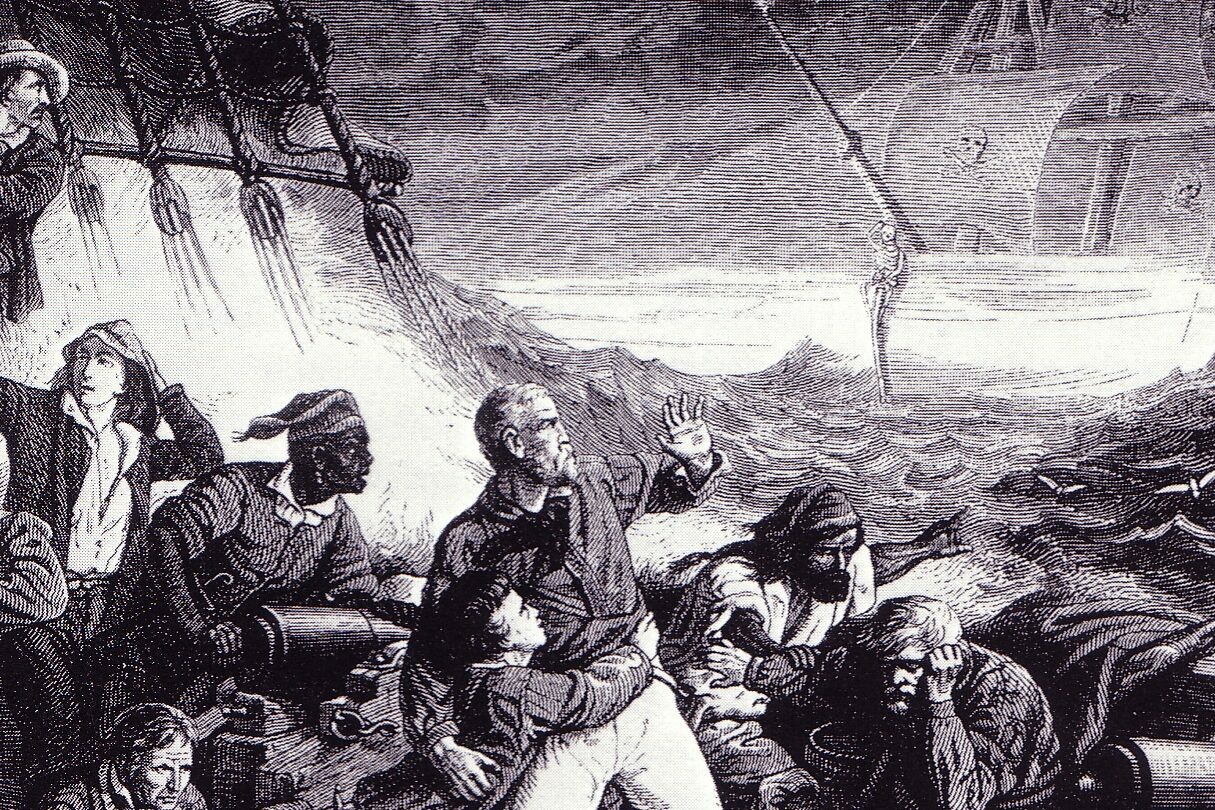
After the overture which summarises major themes of the work, but also foretells the tempestuous mood of the opera, Act I opens on a rocky part of the Norwegian coast. Daland has just anchored his ship in a bay to escape the worst of a storm and clambered ashore to get his bearings. Seven miles short of their destination, Daland can see his house; he was close enough to anticipate the warm embraces of his daughter, Senta. Then this storm blew up. But now the storm abates. Daland’s crew are exhausted and he bids them rest, leaving the Steersman in charge.
The Steersman sings in praise of the south wind that brings him home to his sweetheart [STEERSMAN: ‘Mit Gewitter und Sturm aus fernen Meer...’]. Drowsy, he does not notice the ship with blood-red sails that has approached and dropped anchor nearby. He sings another phrase; then falls asleep.
The other ship’s captain appears. ‘The time is up’, reflects the newcomer [DUTCHMAN: ‘Die Frist ist um...’]. Every seven years he is permitted to land and find relief from the eternal tossing on the waves to which he has been condemned. But respite is brief and he must soon return to the sea. Try as he might, he cannot find death. Was the angel who interceded for him mocking, when she showed him the way to his salvation? There is no woman on earth who could be faithful unto death. The newcomer looks forward to Judgement Day, when all the dead shall rise up, and he can fade into the void. Likewise doomed to wandering, his crew echo his longing for extinction.
Daland re-emerges on deck, alarmed to discover that his Steersman has not seen the strange ship. Hailed by Daland, the newcomer tells Daland only that he is a Dutchman. He gives another account of his journeys [DUTCHMAN: ‘Durch Sturm und bösen Wind verschlagen...’] and offers Daland riches if Daland will give him shelter for the night; all his riches if Daland will give him a home – and wife. Daland can’t believe his luck [DUET - DALAND/DUTCHMAN: Wie? Hör’ ich recht?]; all the Dutchman’s treasure in exchange for his daughter!
‘The next favourable wind takes us home,’ says Daland, and the Dutchman promises to follow on behind. Daland’s crew prepares to set sail [CHORUS (REPRISE): Mit Gewitter und Sturm aus fernem Meer...].
Act II
In Daland’s house, the women of the village are spinning [CHORUS: Summ’ und brumm’, du gutes Rädchen...], while Senta daydreams. Though betrothed to Erik, Senta is entranced by a portrait on the wall. When Mary refuses to sing the ballad of the Flying Dutchman, the man in the painting, Senta begins [SENTA: ‘Traft ihr das Schiff im Meere...’]. She sings of a man who swore by all the devils that he could round a cape and then, overheard by Satan, was condemned to sail the seas until released by the love of a faithful woman.
‘Where is this woman?’ asks the girls, and Senta declares that it is she, just as Erik arrives to announce Daland’s return. As the girls prepare for their men, Erik seeks reassurance that Senta returns his love [ERIK: ‘Mein Herz, voll Treue bis zum Sterben...’]. He knows that Daland’s head can be turned by wealth; and that Senta sang that ballad again today. When Senta mocks the idea that Erik could be unsettled by a mere song, Erik narrates his dream [ERIK: ‘Auf hohem Felsen lag ich träumend...’]; how he saw Daland returning with a strange man, the man in the picture, at whose feet Senta threw herself. He saw them embrace and sail away. Senta is excited that the man is looking for her, and Erik flees in despair. As Senta prays that the man in the picture will soon find his true woman...he appears.
Daland bids his daughter make the stranger welcome [DALAND: ‘Mögst du, mein Kind, den fremden Mann willkommen heissen...’]. He has asked for her hand. Does she consent? Receiving no answer, Daland leaves the two alone, and thus begins the long love duet that takes up the rest of the Act (DUET – DUTCHMAN/SENTA: ‘Wie aus der Ferne längst vergang’ner Zeiten...’]. Senta promises obedience to her father’s wishes; the Dutchman warns of the fate that will befall her if she breaks her vow of constancy. Daland returns to ask if the traditional homecoming feast can be combined with that of a betrothal and Senta gives the Dutchman her hand.
Act III
The Norwegian sailors are revelling aboard ship [CHORUS: ‘Steuermann, lass die Wacht!...’] while the strange ship nearby sits silent. Their girls join them and together they try to rouse the other crew. Recounting something of the Flying Dutchman’s tale, they are by turns cocky and apprehensive. Finally, they return to their own fun. The sea around the Dutchman’s ship begins to seethe and his crew awakens to sing of their accursed captain’s unending search for a faithful woman. They terrify the Norwegians, who cross themselves and flee. Gloom and silence once more envelops their ship.
Erik pursues Senta and reminds her of her vow to him [ERIK: ‘Willst jenen Tags du dich nicht mehr entsinnen...’]. The Dutchman overhears and prepares to renounce Senta, committing himself once more to endless torment on the sea. He tells Senta of the fate from which he is sparing her. She had vowed to be true to him, but not before God; therefore, she will not suffer eternal damnation. But Erik’s cries for help have brought Daland and the townspeople to the scene. The Dutchman finally confirms his identity and prepares to set sail. Senta is restrained by Daland and Erik, but as the Dutchman sails away, she breaks their grip and rushes to a cliff. Swearing to be true, she throws herself into the sea. All at once the Dutchman’s ship sinks. Senta and the Dutchman can be seen, clasped in each other’s arms, rising over the wreck, transfigured.
Synopsis, G.K. Williams ©2008 Symphony Australia
Show more...
About the Artists

Asher Fisch
Principal Conductor & Artistic Adviser
Making music with equal ease and command in the opera and symphonic worlds, Asher Fisch conducts a broad repertoire from Gluck to 21st century premieres, with a special command and following for German Romantic and post-Romantic repertoire. Fisch is the Principal Conductor and Artistic Advisor of the West Australian Symphony Orchestra (WASO) since 2014, and from the 24/25 Season is also the music director of the Tyrolean Festival Erl in Austria. He was previously music director of the New Israeli Opera (1998–2008) and Wiener Volksoper (1995–2005) and was principal guest conductor of the Seattle Opera (2007–2013).
In addition to performances with WASO, in the 25/26 Season Fisch guest conducts the Milwaukee Symphony and Düsseldorf Symphony in concert, and returns to the Royal Danish Opera to lead Barrie Kosky’s production of Dialogues des Carmélites, as well as to the Vienna State Opera for Carmen. Other opera productions include Lucia di Lammermoor, Parsifal, and Der Fliegende Holländer in Erl.
Born in Israel, Asher Fisch began his conducting career as Daniel Barenboim’s assistant and kappellmeister at the Berlin Staatsoper. He has built his versatile repertoire at the major opera houses such as the Metropolitan Opera, Lyric Opera of Chicago, San Francisco Opera, Teatro alla Scala, Royal Opera House at Covent Garden, Bayerische Staatsoper, and Semperoper Dresden. Fisch has conducted at leading American symphony orchestras including those of Boston, Chicago, Cleveland, New York, and Philadelphia. In Europe, he has appeared at the Berlin Philharmonic, Munich Philharmonic, London Symphony Orchestra, Leipzig Gewandhaus Orchestra, and the Orchestre National de France, among others.
Fisch’s recent engagements included Ariadne auf Naxos with the Israeli Opera, La bohème, Parsifal, and the “Verdi trilogy” of Rigoletto, ll trovatore, and La traviata in Erl, the Spain premiere of Aribert Reimann’s Lear at Teatro Real de Madrid, Carmen at Wiener Staatsoper, Lohengrin and La forza del destino at Teatro Comunale di Bologna, Cavalleria Rusticana & Pagliacci at Tokyo Metropolitan Theatre, and Tannhäuser at Opera Australia, as well as orchestral performances with the Israel Philharmonic Orchestra; Sydney, Queensland, and New Zealand Symphony Orchestras in the Oceania region; and Indianapolis, Kansas City, Oregon, and Seattle Symphony Orchestras in North America.
Fisch’s award-winning discography includes Bruckner’s Symphony No.8, Wagner’s Tristan und Isolde, and tenor Stuart Skelton’s debut solo album Shining Knight, all recorded with WASO. His critically acclaimed releases also feature Ravel’s L’Heure Espagnole with the Munich Radio Orchestra and the complete Brahms symphonies with WASO, released on ABC Classic. His two recordings of Wagner’s Ring cycle — with the Seattle Opera and the State Opera of South Australia — garnered widespread acclaim, with the latter winning ten Helpmann Awards, including Best Opera and Best Music Direction.
In addition to his conducting achievements, Fisch is an accomplished pianist. His solo recording of Wagner piano transcriptions for the Melba label showcases his versatility and artistry.
Asher Fisch appears courtesy of Wesfarmers Arts.
Show more...
About the Artists

Christopher Maltman
The Dutchman
One of the most sought-after dramatic baritones of today, Grammy Award-winner Christopher Maltman has appeared to wide acclaim at the world’s leading opera houses, including the Royal Opera House, Salzburg Festival, Wiener Staatsoper, Metropolitan Opera, Bayerische Staatsoper, Deutsche Staatsoper Berlin and Teatro alla Scala. Initially renowned for his Mozart interpretations, his ever-expanding repertoire now encompasses roles such as Iago Otello, Wotan in Wagner’s Ring cycle, Jochanaan Salome, Hans Sachs Die Meistersinger von Nürnberg, Scarpia Tosca and the title role in Enescu’s OEdipe.
This season sees Maltman make two major role debuts: the Dutchman in Der fliegende Holländer with the Bayerische Staatsoper (including a tour to Shanghai) and at the Tiroler Festspiele Erl, and The Wanderer in Barrie Kosky’s new production of Siegfried at the Royal Ballet & Opera. Other highlights include Don Pizarro Fidelio and Don Alfonso Così fan tutte at the Wiener Staatsoper and Scarpia Tosca at both Staatsoper unter den Linden and Wiener Staatsoper. On the concert platform, he returns to Teatro alla Scala as the Narrator in Schoenberg’s A Survivor from Warsaw under Riccardo Chailly, performs Elgar’s The Dream of Gerontius with the Yomiuri Nippon Symphony Orchestra and Der fliegende Holländer with the West Australian Symphony Orchestra.
Recent engagements include Wotan Das Rheingold and Leporello Don Giovanni at the Royal Ballet & Opera; Scarpia Tosca at the Staatsoper Berlin; Iago Otello at Bayerische Staatsoper; Count di Luna Il Trovatore at Washington National Opera; Amfortas Parsifal at the Grand Théâtre de Genève; Ford Falstaff at the Metropolitan Opera; Wotan Die Walküre at the Teatro di San Carlo; Rigoletto at Staatsoper Berlin; and Mandryka Arabella at Wiener Staatsoper.
Maltman’s previous concert appearances include collaborations with orchestras such as the Chicago Symphony Orchestra, Boston Symphony Orchestra, New York Philharmonic and London Symphony Orchestra, working with artists such as Sir Simon Rattle, Valery Gergiev, John Adams, Esa-Pekka Salonen and Sir Colin Davis. Recent concert highlights include Mahler’s Symphony No.8 at the Wiener Konzerthaus and Beethoven’s Ninth Symphony with the Münchner Philharmoniker.
A graduate in Biochemistry from the University of Warwick, he studied singing at the Royal Academy of Music. His breakthrough came when he won the Lieder Prize at the 1997 Cardiff Singer of the World Competition. He remains a distinguished interpreter of Lieder, with a wide-ranging discography that includes the Grammy Award-winning recording of John Corigliano’s The Ghosts of Versailles.
Show more...
About the Artists

Anna-Louise Cole
Senta
Australian soprano Anna-Louise Cole has built a distinguished career on both operatic and concert stages, and is particularly recognised for performing some of the most demanding roles in the dramatic soprano repertoire.
At Opera Australia she has sung the title roles in Turandot and Aida, Venus in Tannhäuser, and Gerhilde and the Third Norn in the 2016 Ring cycle in Melbourne, earning Green Room Award nominations for both performances. In the company’s 2023 new production of Der Ring des Nibelungen in Brisbane, she sang Sieglinde in the first two cycles and made her debut as Brünnhilde in the third, consolidating her reputation as a leading Wagnerian soprano. She reprises Turandot in the 2026 season.
Elsewhere in Australia and abroad, Anna-Louise has sung Chrysothemis in Elektra for Victorian Opera, Lady Macbeth in Macbeth for Opera Queensland, and Elsa in Lohengrin at Teatro Comunale di Bologna. Other credits include the title role in Tosca, First Lady in Die Zauberflöte and Der Friedensbote in Rienzi. As a member of the Wiener Staatsoper Principal Ensemble, she performed Melanie in the children’s opera Patchwork and covered major roles including Tosca, Amelia in Un ballo in maschera, and Donna Anna in Don Giovanni.
Anna-Louise has appeared as soloist in Mahler’s Symphony No.2 with the Zelman Symphony, and Symphony No.8 with the West Australian Symphony Orchestra and with Sydney Philharmonia Choirs at the Sydney Opera House. In recital she has presented Wagner’s Wesendonck Lieder, Berg’s Seven Early Songs, and works by Richard Strauss and Josef Marx. She returns to the West Australian Symphony Orchestra in 2026 as Senta in The Flying Dutchman.
Born in Melbourne, Anna-Louise’s distinctions include the Dame Heather Begg Memorial Award with the Melba Opera Trust, and the Opera Foundation for Young Australians Vienna State Opera Award and AIMS Sundell Study Award.
Artist Q&A with Anna-Louise Cole
You’ve performed internationally and are now based in Europe. What does it mean to be performing this role in Australia with WASO?
I was absolutely thrilled to be offered this role, particularly to be able to create it with WASO under the baton of Maestro Fisch. WASO is an incredible orchestra and our performances of Mahler 8 in 2024 were just so incredibly special. Maestro Fisch is an expert in this repertoire, and I can’t wait to hear his insights into my character and the opera!
What would you say to someone experiencing The Flying Dutchman for the first time?
This is one of the best Wagner operas to start with for anyone curious about what all the fuss is about! Listen out for the stirring sailors’ choruses and the incredible way Wagner paints the sea through the music, stay for the love triangle and high notes! Keep your ears open for the wind machine near the end!
Read the full interview with Anna-Louise here.
Show more...
About the Artists

Daniel Sumegi
Daland
Australian bass-baritone Daniel Sumegi has enjoyed an extensive international career spanning more than three decades, singing over one hundred operatic roles on many of the world’s leading stages. He has appeared with the Metropolitan Opera, San Francisco Opera, Los Angeles Opera, Washington National Opera, Seattle Opera, and Opera Australia, as well as major houses throughout Europe and Asia, including those in Paris, Barcelona, Tokyo, Hong Kong, Hamburg, Cologne, and Frankfurt.
A distinguished Wagnerian, Daniel has performed widely in the composer’s major works. He recently made his debut as Wotan/The Wanderer in Opera Australia’s new production of Der Ring des Nibelungen and has appeared extensively throughout the Ring Cycle: as Hagen for Opera Köln, New National Theatre Tokyo, Opera Australia, Seattle Opera and State Opera South Australia; Fafner for San Francisco Opera, Atlanta Opera and Seattle Opera; and Fasolt for Opera Australia. He has also sung Hunding for San Francisco Opera, and in concert with the Hong Kong, Atlanta, Stuttgart and Melbourne Symphony Orchestras.
His Wagnerian repertoire further includes the title role (Die Fliegender Holländer) for Malmö Opera, and Klingsor (Parsifal) for the Gran Teatre del Liceu and State Opera South Australia, as well as Kurwenal (Tristan und Isolde), Hermann (Tannhäuser) and Heinrich der Vogler (Lohengrin) for Opera Australia.
Beyond Wagner, Daniel has appeared in a broad range of leading bass and bass-baritone roles across the repertoire, such as Baron Ochs (Der Rosenkavalier), Sarastro (Die Zauberflöte), the Commendatore (Don Giovanni), the Grand Inquisitor (Don Carlo), Sparafucile (Rigoletto), Scarpia (Tosca), and the Four Villains (Les contes d’Hoffmann), among many others.
Recent highlights include Escamillo (Carmen) and the title role in Bluebeard’s Castle for Opera Australia, Old Hebrew (Samson et Dalila) for Seattle Opera, Ramfis (Aida) for Opera Maine, Jochanaan (Salome) for Victorian Opera, and his music theatre debut as Judge Turpin (Sweeney Todd) in Sydney and Melbourne.
Show more...
About the Artists

Paul O'Neill
Erik
Australian tenor Paul O’Neill has performed in leading opera houses and concert halls across Europe and Australasia. With Opera Australia, he has performed Pinkerton (Madama Butterfly), Alfredo (La traviata), Rodolfo (La bohème), Narraboth (Salome), and The Duke (Rigoletto).
A frequent principal with West Australian Opera — his home company — he has appeared as Pinkerton, Manrico (Il trovatore), the Prince (Rusalka), Don José (Carmen), Cavaradossi (Tosca), the title role in Otello, Alfredo, Rodolfo, Turiddu (Cavalleria rusticana), Canio (Pagliacci), and The Duke. He returns in 2026 as Lensky (Eugene Onegin) and Alfredo. Elsewhere in Australia, Paul has sung Macduff (Macbeth) for State Opera South Australia.
Formerly an ensemble member of the Berlin Staatsoper, his international engagements include the title role in Faust for Theater Münster, Theater Hagen and the Mainz State Theatre; Cavaradossi in Magdeburg; and Pinkerton in a touring production throughout China. He has also performed The Duke with Opera Holland Park and the state theatres of Karlsruhe and Mainz; Rodolfo with New Zealand Opera; Turiddu and Cavaradossi for Theater Bielefeld; and Jason in Médée for both Theater Bielefeld and the Mainz State Theatre.
He has appeared as Don José at the Glyndebourne Festival; Laca (Jenůfa) for Opéra de Lille; Rodolfo for Halle Opera; Elvino (La sonnambula) and Laca with Graz Opera; Radamès (Aida) at the St Margarethen Opera Festival; and the Prince (Rusalka) at the State Theatre of Saarbrücken.
His concert repertoire includes Mendelssohn’s Elijah under Seiji Ozawa and Haydn’s Orlando Paladino under Nikolaus Harnoncourt (Berlin Philharmonic); Beethoven’s Symphony No.9 (Rheinland-Pfalz State Philharmonic, Beethoven Orchestra in Bonn); Verdi’s Requiem, Mahler’s Symphony No.8 and Siegmund in Die Walküre (West Australian Symphony Orchestra); and Britten’s War Requiem (WASO, Düsseldorf Symphony).
He returns to WASO this season as Erik (The Flying Dutchman) and performs Verdi’s Requiem with the Canberra Symphony.
Show more...
About the Artists

Ruth Burke
Mary
Ruth Burke is an Irish-Australian mezzo-soprano. Ruth graduated from the West Australian Academy of Performing Arts in 2022 and was a 2024/25 Wesfarmers Young Artist with West Australian Opera. Professional highlights so far have included singing Prince Orlofsky in Die Fledermaus with West Australian Symphony Orchestra conducted by Asher Fisch, Kate Pinkerton in Madama Butterfly with West Australian Opera (WAO), Second Woman/Second Witch in Dido and Aeneas (WAO), Rosina in Barber of Seville with Freeze Frame Opera (FFO), and Hansel in Hansel and Gretel (FFO).
Ruth has also performed as the mezzo soloist in Handel’s Messiah with Perth Symphonic Chorus, Mozart’s Requiem with UWA Choral Society, and Beethoven’s Symphony No.9 with Darwin Symphony. In 2024/25 Ruth travelled to Austria to study at Stimme Leib und Seele where she studied the role of Der Komponist in Ariadne auf Naxos, working with conductor Jennifer Condon as well as guest artists.
Show more...
About the Artists

Andrew Goodwin
Steersman
Tenor Andrew Goodwin’s appearances with opera companies include the Bolshoi Opera, Gran Theatre Liceu Barcelona, Teatro Real Madrid, La Scala Milan, the National Centre for the Performing Arts Beijing, Opera Australia, and Sydney Chamber Opera.
On the concert platform, he has toured with the St Petersburg Philharmonic Orchestra, is a regular guest with all the Australian Symphony Orchestras, and has given recitals at Wigmore Hall, Oxford Lieder, Port Fairy, Huntington, Coriole, Bendigo, Huntington, and Canberra International Music Festivals.
This year Andrew features in recital at Bendigo and Orange Chamber Music Festivals and returns to Melbourne Bach Choir as Evangelist (St. Matthew Passion), to Sydney Philharmonia Choirs (Creation), Sydney Symphony (Mozart’s Requiem) with Stephen Layton, and Tasmanian Symphony (Messiah).
Andrew’s roles for Opera Australia include Fenton (Falstaff), Belmonte (Die Entführung aus dem Serail), Don Ottavio (Don Giovanni), Novice (Billy Budd), Janek (The Makropulos Secret), and Tamino (Die Zauberflöte). He has sung Tamino, Alfred (Die Fledermaus), and Lensky (Eugene Onegin) at the Bolshoi; Silvio in Martin Y Soler’s L’Arbore di Diana in Barcelona; Gomatz in Mozart’s Zaide with The Classical Opera Company, London; the title role in Stravinky’s The Rake’s Progress with Auckland Philharmonia; Boris (Katya Kabanova) with Victorian Opera; Nadir (The Pearlfishers) for State Opera South Australia; Lysander (A Midsummer Night’s Dream) at Adelaide Festival, and Egeo (Giasone), Florival (L’amant jaloux), Orpheus (L’anima del filosofo), and the title role in Artaxerxes (Hasse) for Pinchgut Opera.
His recordings include Schubert’s Die schöne Müllerin, Winterreise, and When yesterday we met (songs of Rachmaninov and Tchaikovsky) for ABC Classics, and Artaxerxes, Giasone, L’ámant jaloux, and L’anima del filosofo with Pinchgut Opera. Born in Sydney, Andrew studied voice at the St. Petersburg Conservatory and in the UK with Robert Dean. The winner of multiple awards and scholarships, he has also received support from the Australian Music Foundation and ARS Musica Australis.
Show more...
About the Artists

WASO Chorus
Formed in 1988, the WASO Chorus is comprised of volunteer choristers who represent the finest form of community music-making, bringing together singers from all walks of life. They regularly feature in the WASO annual concert season and are directed by Hugh Lydon.
The Chorus has built an international reputation for its high standards and diverse range of repertoire. While its main role is to perform with the West Australian Symphony Orchestra, the Chorus also maintains a profile of solo concerts, tours, and community engagements.
The Chorus sings with the finest conductors and soloists including Asher Fisch, Simone Young, Stephen Layton, and Paul Daniel. Recent highlights have included Mahler’s Symphony No.8 and Britten’s War Requiem. In 2019, the Chorus performed at the Denmark Festival of Voice and in 2018 toured China with performances of Orff’s Carmina burana.
In 2020, they performed two Gala events on the Kalbarri Skywalk. In 2023, the Chorus was invited to Hobart to perform Brahms’ German Requiem with the Tasmanian Symphony Orchestra (TSO), the TSO Chorus, Sydney Philharmonia Choirs, and members of the public, conducted by Simon Halsey.
In 2024, the WASO Chorus performed with members of the WA Opera Chorus, the UWA Symphonic Chorus, Voyces, and Aquinas College’s Schola Cantorum in WASO’s presentation of Mahler’s Symphony No.8.
Hugh Lydon Chorus DirectorGladys Chua Répétiteur
Show more...
About the Artists

West Australian Opera Chorus
West Australian Opera Chorus regularly appears in the mainstage and concert performances for the state opera company. Led by West Australian Opera’s Artistic Director Chris van Tuinen, the West Australian Opera Chorus features 40 professional opera singers from across Western Australia.
For almost 60 years, the West Australian Opera Chorus has brought musical and dramatic life to countless performances and transported audiences to new worlds of discovery.
In recent productions, the West Australian Opera Chorus appeared in Verdi’s Il trovatore conducted by West Australian Symphony Orchestra Principal Conductor Asher Fisch, and a return season of La traviata in March 2026. The Chorus will feature prominently in upcoming seasons at His Majesty’s Theatre, Tchaikovsky’s Eugene Onegin in August, and Roméo et Juliette by Gounod in October.
Show more...
About the Music

Richard Wagner
(1813–1883)
Der fliegende Holländer
The drama of The Flying Dutchman functions on three levels. Firstly, there is the external world represented by Daland, Erik, Mary, and the villagers. Theirs is a prosaic existence governed by the conventions of village life and traditional ways of doing things. Their music follows styles and forms that were familiar to audiences of the day.
Secondly, there is the internal world of the Dutchman and Senta, for which Wagner wrote a new type of music that dispensed with traditional forms and foreshadowed what was to come in his later works. The Dutchman comes from beyond the horizon – he is from the past and the future – condemned by his own hubris to sail the seas until the day of judgment. He can find redemption only through the love of a faithful woman. Senta, the daughter of the Norwegian merchant captain Daland, hankers for a life beyond the suffocating constraints of the village. Marriage to the young hunter Erik would simply perpetuate this claustrophobia, and it is not what she has in mind. In fact, Senta has long been obsessed with the story of the Flying Dutchman, and she is convinced of her destiny to save this tragic figure.
Thirdly, there are forces beyond the control of any of the characters. These are natural forces – the forces of fate – expressed through orchestral depictions of sea, storms, and wind. Even the famous Spinning Chorus in Act Two is not a folkloric episode but the domestic equivalent of the gales encountered in the Act One. The girls sing of the whirringspinning wheels that will generate the wind to blow their boyfriends home.
The songs of the Norwegian sailors and the Dutchman’s ghostly crew also reveal the forces of nature and the supernatural. Both crews are men of the sea who will soon return to it, but the Dutchman’s sailors have been at sea for centuries, making landfall only once every seven years. They are tragic figures, condemned with their captain to roam the vast oceans of the world for eternity. In some of the stories on which the opera was based, we learn that whenever the Dutchman’s ship encounters other vessels at sea, its crew try to pass on letters for loved ones ashore, only to be told that those loved ones have been dead for generations – and the sailors weep. They are figures to be pitied, not rejected or scorned – victims of the curse of eternal wandering.
When Daland and the Dutchman meet for the first time in Act One, when their ships have taken shelter from a storm on the Norwegian coast, they find that they have an interest in common – the marriage of Daland’s daughter Senta. Daland will receive a valuable dowry, and the Dutchman will finda wife to be the instrument of his salvation.
So, Senta’s marriage is the desired outcome of both Daland and the Dutchman (though for different reasons) and this explains their lively exchange in the Act One. Daland says: “What? Do I hear rightly? Make my daughter his wife? Could any son-in-law be more welcome? I’d be a fool to pass up the good luck. I’m delighted to agree.” And overlapping these short phrases, the Dutchman sings in long cantilenas: “Ah, I’m without wife, without child, and nothing binds me to this earth. Consent to this marriage, and you may take all my riches.”
Although The Flying Dutchman had its musical roots in German romantic opera, it was the work in which Wagner found his voice. Many years later he insisted, rightly, that it marked the beginning of his career, and he returned to its dramatic themes again and again.
The Dutchman is certainly other-worldly; he comes from another age, another century. There must have been other visitors to the village from time to time as ships came into port or took shelter from storms, and they passed virtually unnoticed. But not the Dutchman. The stage directions describe him as a pale man dressed in a Spanish costume – a reference to his origins in the 17th century when the Netherlands was ruled by the Spanish Habsburgs, something that we recall from Verdi’s Don Carlos and Beethoven’s Egmont.
Only Senta understands this strange man and his predicament, and that is the key to the drama. “He flies on like an arrow,” she says, “without goal, without rest, without peace.” The other girls have probably heard the tale of the Flying Dutchman before. Mary, the housekeeper certainly knows it but, in Act Two, we’ll hear it recounted once again, not by Mary but by Senta.
And so, to the Spinning Chorus. “My love is out on the sea” sing the girls, “thinking of home and his beloved child. My good wheel – hum and buzz. Ah, if you could summon up the wind, he’d quickly be here.” Then Senta sings her ballad. To the girls it’s just a spooky folk tale, but to Senta it’s an article of faith, and the portrait has become a religious icon. She gets to know the Dutchman through the portrait, just as Tamino in The Magic Flute gets to know Pamina from her likeness. “Hui! How the wind shrieks! Yohohe! Hui! How it whistles in the rigging! Yohohe! Hui! It flies like an arrow, without goal, without rest, without peace. Yet this pale man may one day find salvation, if he can find a wife who would remain true to him on this earth, until death!”
Senta encounters the Dutchman when her father brings him home. Daland’s jaunty aria is reminiscent of Berlioz. Mögst du, mein Kind – “Will you, my child, be friendly to this man? From your heart he asks a holy gift. Give him your hand – for bridegroom you should call him. If you agree with your father, tomorrow he’ll be your husband. See this bracelet, see these buckles, these are but the smallest part of his possessions. Surely, dear child, you would love to have them? They are yours, when you exchange rings … But no one speaks. Am I an intruder here? … May you win this noble man. Believe me, such fortune will not come again.” The music keeps stopping and starting as if something is amiss – which indeed it is. As Daland expects, Senta is drawn to the Dutchman, but there is a tension in the air that her father doesn’t understand, and eventually he leaves the room.
The duet between Senta and the Dutchman that follows is not a ‘love duet’ in a conventional sense. It’s a moving expression of the Dutchman’s hope for salvation and Senta’s determination to be its instrument through ‘faithfulness until death’. The Dutchman is looking for the peace of ‘eternal oblivion’.
Wagner excelled in creating strong, singleminded, even visionary women, whereas so many of his complex men struggle to reconcile conflicting forces within themselves. Many are outsiders, and many are engaged on long journeys – think of Tannhäuser, Lohengrin, Wotan, and Parsifal – and the Dutchman. A psychoanalyst might look to Wagner’s own childhood for an explanation – the loss of his father and then stepfather at an early age, the maternal affection that he craved but rarely received, and dependence on his talented sisters during his formative years. He needed the company of women throughout his life – especially women who believed in him and could be his soulmates – women like Mathilde Wesendonck and Cosima von Bülow.
Central to the opera are dramatic themes that keep reappearing in the composer’s later works. Take for instance the role of dreams and illusions. Senta and the Dutchman inhabit the realm of dreams. Senta’s deeply troubled suitor Erik catches a glimpse of this through a dream of his own in which he has seen her leaving with the Dutchman and sharing his watery fate. Erik relates this vision as a warning, but his words merely strengthen Senta’s resolve.
Sixty years later, Sigmund Freud and a small group of his friends took an interest in Wagner’s The Flying Dutchman and in Erik in particular, and they published a paper on it. The Interpretation of Dreams was a seminal work published in 1899. Freud considered dreams to be ‘the royal road to the unconscious’ because, through them, the ego’s defences are lowered and repressed ideas turn into ‘awareness’. Perhaps Erik’s dream signifies that if he can’t have Senta, then no one else can.
Senta is mesmerised by the vision of how her father brings a mysterious stranger to the house, but when Erik recounts how she flees with the stranger across the ocean, she realises that she must be the woman the Dutchman is looking for! Erik, in despair, accuses her of being ensnared by Satan.
As was often the case, Wagner was ahead of his time in introducing philosophical and psychological ideas into his dramas. Dreams feature in many of Wagner’s works – think of Elsa’s dream in Lohengrin and the lovers’ dream of eternal union in Tristan und Isolde. There is Walther’s ‘Morning Dream’ in Die Meistersinger, and Sieglinde’s nightmare in Die Walküre when she anticipates the death of Siegmund.
Then we have the Dutchman’s nihilism and yearning for death. He has tried many times to hurl himself into the abyss, to run his ship onto the rocks and to fall victim to pirates, but the sea always rejects him, and the pirates cross themselves and flee in terror. In Senta he seeks not a wife but the peace of ‘eternal oblivion’. Eventually, Wagner will find a philosophical explanation for this in Schopenhauer’s The World as Will and Representation and in the Buddhist notion of Nirvana – a state of peace that marks the end of desire and the insatiable working of the will.
This awareness is anticipated in the Dutchman’s great monologue Die Frist ist um (‘The Term is up’) in Act One. It finds parallels in Tannhäuser’s yearning for death, Wotan’s desire in Die Walküre for ‘the end, the end’, Tristan and Isolde’s longing for unity beyond time and space, and the determination of Amfortas in Parsifal to end his unbearable suffering. The fact that the Dutchman has lived for centuries, foreshadows the plight of Kundry whose damning act of hubris had trapped her in an endless cycle of rebirth. And what was the Dutchman’s act of hubris? According to the legends, he had sworn by all the devils in hell that, despite a raging storm, he would round the Cape of Good Hope even if he had to keep on sailing until the day of judgement. And so, it came to pass.
We come to the notion of redemption through the love and constancy of a woman. The redeeming quality of a woman’s love is an idea with roots in the Faustian idea of the ‘the eternal feminine’, which continued to fascinate Wagner for another forty years. We find parallels with Elisabeth in Tannhäuser and Brünnhilde in Götterdämmerung. In Lohengrin we see the disastrous results of a lack of constancy.
There are links too to Beethoven’s Fidelio, which had a formative influence on Wagner. In assuring the Dutchman of her devotion, Senta uses the words: ‘Wer du auch seist’ (‘whoever you are’) – the same words used by Leonore in the dungeon scene in Fidelio. When Senta tells the Dutchman that she would ease his suffering, he, like Florestan in his prison cell invoking an angelic Leonore, describes Senta as an angel. The singer who created the role of Senta – Wilhelmine Schröder- Devrient – had also been a famous Leonora and had made a lasting impression on the young Wagner.
And then there is the symbolism of the sea. Water is an ever-present symbol in Wagner’s works. Pristine gold is stolen from the Rhine, and the cursed ring is ultimately returned to it; Tristan und Isolde begins on the sea and ends within sight of it; in Die Meistersinger, reconciliation (personal and artistic) is achieved on the banks of the river Pegnitz; in Lohengrin, the waters of the Scheldt bring the Grail Knight to the people of Brabant and then separate him from them, and the sacred lake in Parsifal is the site of Parsifal’s lesson in compassion.
The image of a ship at the mercy of the sea can be compared with the storm-tossed human soul in its earthly existence; and so, the Dutchman becomes a metaphor for all mankind. But if the sea is the place of the Dutchman’s torment, it is also the medium through which redemption is finally attained. He had emerged from the sea and Senta follows him back into the sea. We can speak of the sea in metaphysical terms as the unknown reality beyond our familiar world of illusion – an idea that is at the very heart of Tristan und Isolde.
There is one dramatic scene in The Flying Dutchman involving three contrasting groups who interact with each other at the quayside of a Norwegian village. Sailors on the deck of Daland’s ship, relieved to be home after their long voyage, flirt with village girls who are setting up food and wine on the quay. Then both groups take an interest in the mysterious Dutch ship, dark and silent, that lies nearby. The banter between sailors and girls is tossed back and forth like a verbal dance, starting with light-hearted teasing and ending with speculation that the Dutch seamen are silent because they are ghosts and their sweethearts are long dead. When the ghostly crew does finally answer, the rollicking tone of the music is swept away in a terrifying battle of nerves.
Personally, I don’t think Wagner ever stopped being the Flying Dutchman. Forever wandering, he made landfall every so often before moving on again, always yearning for stability and, dare I say it, salvation.
© Dr Peter Bassett
Show more...
About WASO

Engage | Excite | Experience | Educate
From the centre of Perth to the furthest corners of the state, we have provided the soundtrack to life in WA since 1928.
As the State Orchestra, Perth’s first and finest, WASO is the largest employer of performing artists in Western Australia and reaches two million people with musical experiences each year on stage, in our community, and online.
From concert stages to classrooms, hospitals to aged care, we bring joy, inspire learning, and nurture participation in our community, because everybody deserves the opportunity to experience live music. Every year, through community and leading industry partnerships, we engage a new generation of young and emerging artists to help secure a bright future for music in Australia.
We celebrate our rich classical music heritage with great artists from all over the world and commission and perform new repertoire to renew and expand it. The Orchestra collaborates widely with major arts companies and independent artists, performing opera to ballet, movies to musicals, jazz to rock.
Asher Fisch is Principal Conductor and Artistic Adviser of our Orchestra. We champion the diversity of music in all its forms, with a team of talented and passionate people who create unforgettable experiences for all West Australians to enjoy.
Show more...
Your Concert Experience

Get the best out of your concert experience at Winthrop Hall.
- Explore the music
Be sure to take a quick look at the performance schedule or enjoy a deep dive into the music with your concert program online or in the foyer. - Share with your friends
Snap a selfie from your seat, capture the artist bows and share the experience with friends. Don’t forget to tag us! #wasymphonyorchestra - Clap with enthusiasm
Whether you are welcoming your favourite artist to the stage, or showing appreciation at the end of a piece, we love thunderous applause. Not sure when to clap? Here’s a tip; if the conductor’s arm is raised, hold it. If it’s relaxed, go for it! - Respect those around you
Ensure your mobile phone is on silent and does not disrupt the experience of those around you. If you need to cough or sneeze, please do this into your elbow. - Accessible services available
For information about our services, such as lifts and accessible toilets, please ask one of our friendly ushers. - Latecomers admitted at a suitable time
If you arrive late or leave your seat during a performance, your auditorium entry will need to wait until a suitable break. - First Aid available
St John First Aid officers are present at every WASO concert. Please notify a team member if you require any first aid assistance. - Box Office is open
Get tickets to your next WASO experience at the WASO Mobile Box Office located inside the Winthrop Hall foyer. The WASO Mobile Box Office is open 90 minutes before each performance, and during interval. Alternatively, you can visit waso.com.au to buy online or book an in-person ticketing appointment by calling (08) 9326 0000.
Show more...
Supporting WASO
Annual Giving: The Difference You Make
Today’s performance is the result of an extraordinary collaboration: musicians, conductors, guest artists, staff, volunteers and you, the audience.
Underpinning this shared experience is the generosity of WASO’s giving community who donate through our Annual Giving program, one of the most important pillars supporting your Orchestra’s work.
WASO’s Annual Giving program plays an essential role in sustaining your Orchestra. The support of donors enables WASO to present inspiring concerts, engage outstanding artists, and bring symphonic music to audiences across Western Australia.
Gifts made through Annual Giving provide vital, flexible funding that helps support the Orchestra’s artistic and operational life. It supports the musicians who bring each score to life and the teams behind the scenes who ensure every performance meets the highest standard. It also enables education and community programs that introduce young people and new audiences to the experience of live orchestral music.
The difference supporters make is felt in many ways: in the quality of every performance, in the opportunities we create for artists, and in the communities we can reach. Just as importantly, Annual Giving provides stability that allows your Orchestra to plan with confidence.
For many donors, giving is a way to express their gratitude for and belief in the enduring value of music and the role it plays in enriching cultural life in Western Australia.
We invite you to make a gift through Annual Giving. Your generosity helps ensure the music continues to inspire audiences today and for generations to come.
To support WASO’s Annual Giving campaign, visit our website or contact our Philanthropy team philanthropy@waso.com.au and (08) 9326 0016.
Show more...
Our Supporters